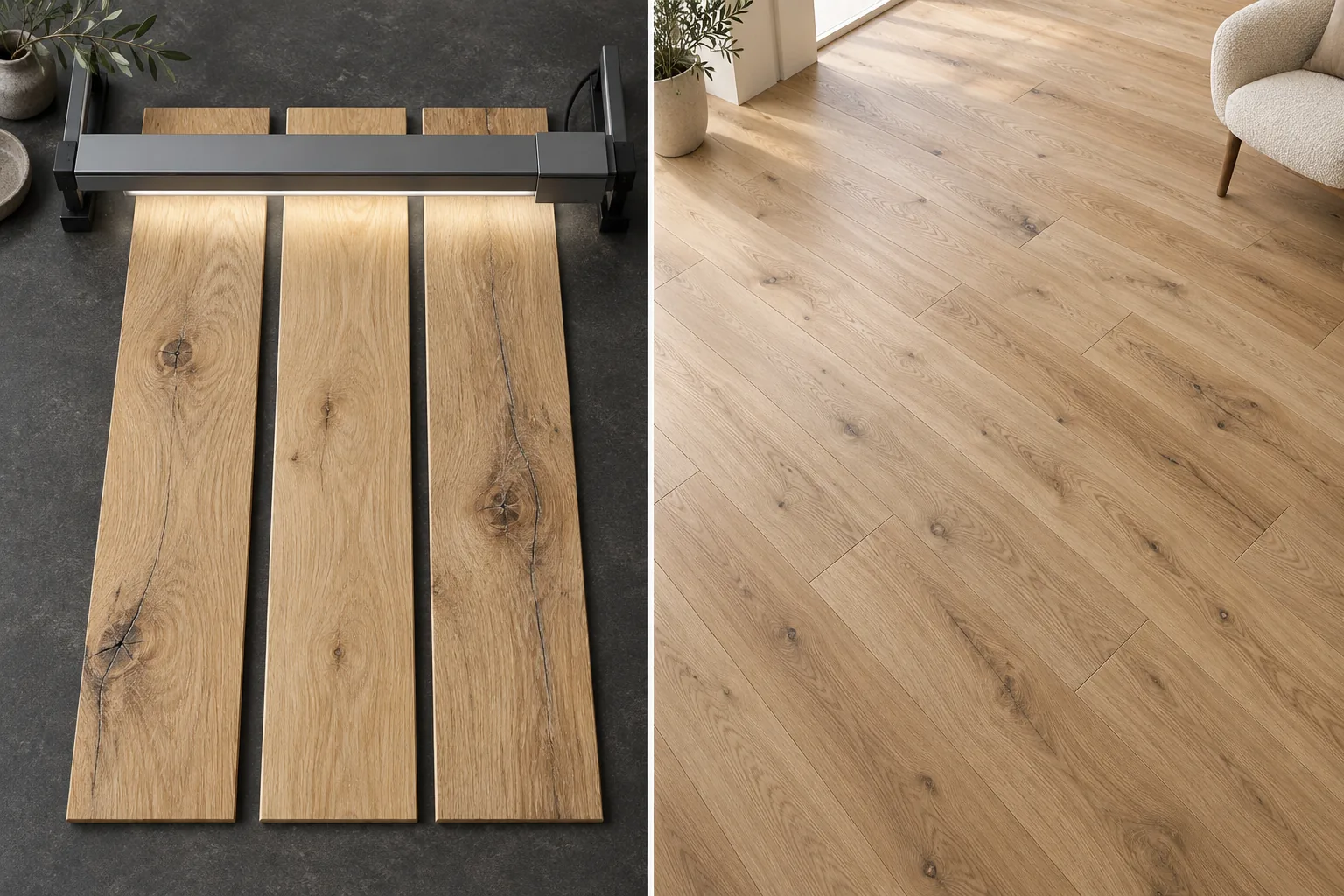
One attractive oak plank can win a sample review. A room full of the same recognisable knot can undo that impression. When you develop a premium SPC collection, the useful design question is how the floor looks across several square metres, not only on the display board.
Digital printing can help reduce visible pattern repetition. To turn that capability into a product you can order and describe accurately, specify the artwork range, finished plank faces, surface texture and packing plan together.
Start your design brief with the natural material
A wood-look decor can begin with selected timber surfaces, scanned and composed into production artwork. Schattdecor's decor-development explanation describes selecting and scanning material, then arranging grain, knots and other features into a coherent layout. Scanning supplies the visual detail; design work determines how that detail is distributed.
For your collection, decide which character you want to retain. A quiet oak may need restrained tonal variation and fewer dominant knots. A more expressive design may use stronger contrasts, while still needing enough different faces to avoid an obvious repeating motif.
Bring a physical reference or a clear visual direction to the discussion. Review the full proposed artwork range before selecting a name and colour for the sample board.
What digital printing can change
Industrial digital printing gives the production process greater flexibility in the artwork it reproduces. Hymmen lists reduced decor repetition among the benefits of its digital printing systems, alongside integration with synchronised texturing. These are process capabilities; they do not establish the face count or minimum order for every floor produced digitally.
Ask which printing route is actually proposed for your SPC product and how much distinct artwork it uses. “Digital” is not a substitute for that answer. Two digitally printed collections may have different design libraries, plank formats and production arrangements.
Keep the visual requirement alongside the construction and intended use when reviewing your SPC flooring collection. A design improvement does not by itself establish a change in wear, scratch or joint performance.
Define what “20 square metres without repetition” means
We can explore digitally printed flooring options with design areas around 20 m², and in some configurations around 30 m². The available area must be confirmed for the selected decor and product. It is not a standard promise for every SPC floor or every production origin.
Three different measurements can be hidden inside a non-repeating claim:
| Measurement | What it tells you | What still needs confirmation |
|---|---|---|
| Unique artwork area | The size of the available design before repetition | How that artwork is cut into finished faces |
| Number of plank faces | The distinct face library for a particular format | Which faces are included in a carton or order |
| Installed area without duplicates | The intended result of a defined face selection and layout | Packing, identification and installation sequence |
Consider a purely illustrative calculation: 40 different faces, each covering 0.25 m², represent 10 m² of unique plank faces. That arithmetic does not mean a randomly selected 10 m² delivery contains all 40 exactly once. Face distribution matters. These numbers explain the calculation; they are not specifications for a product we offer.
If an installed area without duplicate faces is essential, state the area and the required selection explicitly. Agree how cartons, face identification and laying instructions will support it before making that promise to your customers.
Specify the texture as a separate decision
A varied printed image and a texture aligned with that image are different attributes. Digital printing does not automatically include synchronised embossing.
Hesse Lignal's digital lacquer embossing overview explains a digitally controlled route to textured surfaces. For your proposed floor, ask which texturing process is used and review whether the relief follows the printed grain on the finished sample.
Evaluate gloss, texture depth and alignment together. Look across the assembled floor as well as closely at individual features. A surface can feel appealing on one sample while a repeated highlight or strong texture becomes distracting across a larger area.
Approve a face set you can order again
Request a representative layout showing the proposed face range. Identify dominant knots, repeated streaks and abrupt colour changes. Record which variation is intentional and which sample set becomes the approval reference.
Then connect that approval to the commercial order: decor reference, plank dimensions, face library, carton mix, permitted rotation and replacement identification. Ask what happens if an extra carton is needed later. A matching decor name alone does not establish that it will reproduce every position in a planned layout.
If the programme may move between manufacturing origins, repeat the finished-product review rather than assuming that shared artwork guarantees the same result. Our guide to decor continuity across origins explains how to retain the collection reference through that change.
Flooring & Panels can help develop the brief around your natural-material reference and the room-scale result you want. Use the specification guide to bring the visual target, format and purchasing requirements into one enquiry. The outcome should be a defined face set and finish you can approve, order and explain with confidence.
Cover: AI-generated concept illustration of timber scanning and a varied wood-look floor, not a photograph of equipment or a supplied SKU.