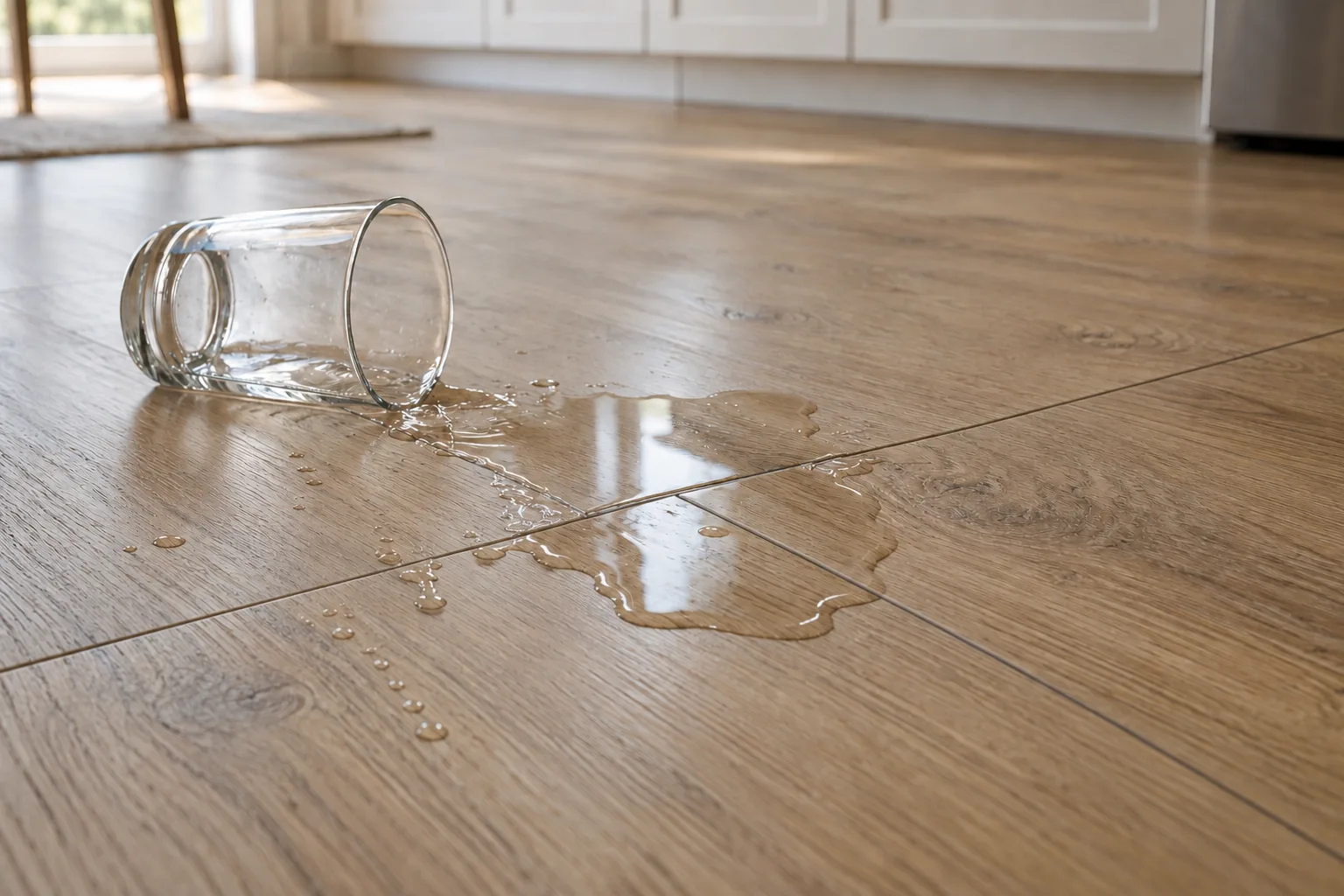
If you want to sell an SPC collection for kitchens and everyday spills, “waterproof” is an attractive headline. It also leaves an important purchasing question unanswered: exactly which part of the floor has been assessed, and under what conditions?
Before approving the packaging, connect that word to the selected plank, assembled joints and installation instructions. Your collection needs a defined water-performance specification that can travel from the quotation to the product page without changing meaning.
Begin with the claim you want your collection to make
Write down the intended application and expected exposure. An occasional household spill, prolonged standing water and a shower floor are different requirements. Ask whether the proposed product is suitable for each application you intend to name, rather than assuming that a waterproof core settles the question.
Use three separate lines in your specification:
- Plank behaviour: what the product itself does under the stated water exposure.
- Joint behaviour: whether water can pass through the assembled long and short connections under the tested conditions.
- Installation scope: the required details at the perimeter, doorways, pipes and other interruptions, plus excluded applications.
Keep those distinctions when comparing SPC flooring options. A test on an individual board does not establish the behaviour of an installed room.
Ask for the exact joint configuration
A locking-system family name is useful identification, but the water-sealing arrangement needs its own confirmation. Välinge's 2G PRO technical sheet, for example, describes combining the locking system with Dry technology for watertight joints. That is a technology-owner claim for the specified configuration, not proof that any SPC product with a similar click profile has the same performance.
In your enquiry, request the actual locking configuration, any sealing treatment and the evidence for the proposed finished product. Keep the result connected to the construction, dimensions and factory reference you will order. Our click-systems overview helps you frame that part of the enquiry.
A brochure can explain a technology. Approval needs enough product identification to establish whether the evidence belongs to your collection.
Make the water test question precise
“Passed water test” is not a complete answer. Ask what was exposed, for how long, how it was assembled and what counted as a pass. Establish whether the assessment measured changes to the plank, leakage through connections, or both.
A practical review sheet can keep the missing information visible:
| Approval item | What to record |
|---|---|
| Product identity | Construction, dimensions, click configuration and sealing treatment |
| Test arrangement | Individual board or assembly; long and short joints included |
| Exposure and result | Method, duration, conditions, acceptance criteria and actual findings |
| Installation details | Perimeter, openings and junctions; permitted materials and movement requirements |
| Customer-facing documents | Matching product claim, installation instructions, care guide and warranty |
If the report leaves a question unanswered, request clarification before widening the claim. A successful result for one arrangement should not silently become permission for every installation.
Check the installation before writing “bathroom suitable”
The perimeter remains part of the system. A joint between two planks and the junction between flooring and a wall are different details. Do not invent a sealing method or fill an expansion space with an arbitrary material to complete the story.
Quick-Step's Alpha Vinyl Pad Herringbone installation instructions, version May 2025, illustrate this distinction with specified finishing details and exclusions for applications including shower enclosures and rooms with built-in drainage. Those instructions belong to that named product; use the approved instructions for your own flooring.
For your range, obtain a clear answer on permitted rooms and excluded exposure. Keep floor and wall-system approvals separate too: suitability of a bathroom wall panel does not establish suitability of a floating floor beneath it.
Align the promise across your sales materials
Review the package, sample-board label, online listing, installation guide and warranty together. They should describe the same protection. Check what remedy is offered, which conditions apply and whether consequential damage is addressed; do not infer those terms from the word waterproof.
A useful final review asks: could your sales team explain the claim without adding assumptions? If the answer depends on a missing installation detail or an unidentified report, the specification is not ready for that promise.
Flooring & Panels can help organise your product brief across manufacturing options in Vietnam, Thailand and China. Put the intended application and the evidence you need in the specification guide so each offer is assessed on the same basis.
You then have a collection defined by a specific, supportable water-performance claim, with the documents needed to explain it consistently.
Cover: AI-generated illustration of a household spill on an oak-look floor. It does not show a product water test.